OTTKaliki Avatar - The Odisha Think Tank
Join usSitemap
Kaliki Avatar dharma chakra logo
Kaliki Avatar - The Odisha Think Tank
OTT banner amber
OTT banner royal-blue
OTT banner maroon
OTT banner forest
OTT banner purple
OTT banner teal
OTT banner saffron
OTT banner charcoal
IMPACTS

Mahapurush - The Voices of Ages

ମହାପୁରୁଷ · Timeless wisdom
VIBES

Living Voices - From the Field

ଜୀବନ୍ତ ସ୍ୱର · The most powerful statements today
News
Odisha

Strategic Policy Perspectives for a Rising Odisha

Essays and briefs that read Odisha’s questions in their civilisational depth and answer them with verifiable fact.

~ OTT Policy Desk

Implementation advocacy follows each policy input into the field until it changes practice on the ground. Chapters track the file, the budget line, and the outcome.

Read More ❯
Implementation Title
Sanatan Psyche
Odisha Think Tank
Odisha Transformation Highlights
◈✦◈

Odisha extends from 17°49' to 22°34' North Latitude and from 81°27' to 87°29' East Longitude. It has a coastline of about 480 km and its total area is 1,55,707 square km.

Policy

Policy Inputs

Briefs and memoranda submitted to government on questions that touch daily life in Odisha.

Perspectives

Transforming Policy Perspectives

Longer essays that question settled assumptions and set out a civilisational reading of policy.

TIO

TIO - News in Focus

Reports from the Transforming Odisha Initiative as they unfold across the districts.

Education

On Education and Employment

Schools, universities, skills, and the bridge from learning to livelihood.

Infra

On Infrastructure and Development

Roads, ports, power, and the public works that decide Odisha's pace of growth.

Political

On Socio-Political Issues

Society and state in conversation: representation, law, and public institutions.

Culture

On Culture, Heritage & Conservation

Temples, crafts, language, and the duty of care owed to a living heritage.

Ack

Acknowledgements and Comments

Letters, replies, and recognitions received from readers and public offices.

Programmes
Action Programmes
◈✦◈
Climate-Responsive Development and Sustainable Futures

Climate-Responsive Development & Sustainable Futures

Development that answers Odisha's coastline, forests, and changing climate.

Governance Reform, Institutional Innovation and Public Accountability

Governance Reform, Institutional Innovation & Public Accountability

Stronger institutions, cleaner processes, and accountability citizens can see.

Economic Diversification, Industrial Growth and Investment Promotion

Economic Diversification, Industrial Growth & Investment Promotion

Beyond minerals: wider industry, deeper value addition, and new investment.

Agricultural Revitalisation, Food Systems and Rural Prosperity

Agricultural Revitalisation, Food Systems & Rural Prosperity

Farms, markets, and food systems that return prosperity to the village.

Constituency
Constituency Focus
◈✦◈
Constituency focus

Policy Inputs

Constituency notes that carry field evidence into the policy process.

Constituency focus

Policy Inputs

Submissions prepared with Guild experts for departments and commissions.

Constituency focus

Policy Inputs

Short, sourced notes that put verified numbers before decision makers.

Constituency focus

Policy Inputs

Inputs drafted from chapter reports and vetted by the Policy Research Council.

Signature Missions
◈✦◈
➜Odisha Youth Empowerment and Entrepreneurship Blueprint
➜Cultural Diplomacy and Diaspora Missions
➜Banavasi Livelihood & Indigenous Cultural Economy Mission
➜Coastal and Industrial Zones Coordination Platform
➜Art, Architecture & Public Aesthetics Council
➜Digital Odisha Accelerators
➜Youth-Led Enterprises & Internship Acceleration
➜The Next Founders: Students Spark-Catalyst Circle
Live Dashboard & Metrics
◈✦◈
👥 Members
Bar chart - Members growth (Jan–Jul)
📰 Article
Line chart - Articles published (Jan–Jul)
📢 Advertisements
Line chart - Ad performance (Jan–Jul)
Expertise network
Kaliki Guilds - ମଣ୍ଡଳ
◈✦◈
Articles & Research Papers

Freshly Published

ନୂତନ ପ୍ରକାଶିତ ଲେଖା · From the fifteen Action Programmes & Kaliki Fellowship
Call to Action
◈✦◈
Citizen Voices

Odisha's civilisational reform is authored by every citizen. File your ten-point Call to Action - bound to one Transforming Action Programme - and let your voice enter the record. Below, the newest citizen call.


SM

Suryakanta Mohapatra

Educational Reform

“A mother-tongue literacy programme for all 6798 Gram Panchayats - Odia, Kui, Kuvi, Ho, Bonda - by 2028, aligned to NEP 2020.”

Read more ›

ଅଧ୍ୟାୟ ମଣ୍ଡଳAbout the Chapter Network

❋ ◈ ❋

The Odisha Think Tank Chapter Network is how the institution reaches every district of Odisha, every state of Bharat, and every country of the Odia diaspora. A Chapter is not a branch office - it is a self-organising community of members who take the Think Tank’s vision and translate it into local research, local service, and local leadership.

Chapters are the moving parts of a civilisational institution. They convene local scholars, professionals, and volunteers around the fifteen Action Programmes. They document local heritage. They run public-assistance clinics. They mentor youth. They connect the diaspora back to its soil. Every Chapter is tied to the Apex Guidance Council but governs itself in its own idiom.

Eight kinds of Chapter operate under the network - each with its own scale, mandate, and character. Explore each below, and find the one that fits your work.

JOIN THE MOVEMENT · ଯୋଗ ଦିଅନ୍ତୁ

Find Your Chapter - Or Start One

Every Odia - student, professional, homemaker, retiree, resident of Odisha or diaspora - belongs somewhere in the Chapter Network. Find the one closest to your work, or start a new one where none exists yet.

Voices from the Chapters

ଅଧ୍ୟାୟ ସଦସ୍ୟଙ୍କ କଥା · TESTIMONIALS
Member

NISHA ROY

COORDINATOR

State Chapters


Featured Chapter member.

Read full profile ›

Photographs and member profiles shown here are templates - original photographs and profiles are being added.

ସ୍ଥାପନା ଦୃଷ୍ଟିFounding Vision

❋ ◈ ❋
ଉତ୍କଳଂ ଭାରତସ୍ୟ ମାନସପୁତ୍ରଃ Utkalaṁ Bhāratasya Mānasaputraḥ Utkala - the mind-born child of Bharat.

Odisha is a civilisation before it is a state. From the sandbanks of the Daya, where Emperor Ashoka's sword broke and Dharma began, to the wheels of Konark that turned time itself - the land of Utkala has always held a mirror to the world. In every century Odisha has produced sailors who crossed oceans, saints who dissolved caste at Jagannath's door, poets who taught India to feel, and builders who left temples that still school the eye.

The Odisha Think Tank - Kaliki Avatar is a permanent, non-partisan platform for civilisational research, evidence-based policy, and Odia global leadership. It exists to give Odisha's ancient genius its modern institutional form, and to place that wisdom at the service of Bharat and the world.

The Genesis

Founded in the wake of Odisha's civilisational awakening, the Think Tank was conceived at a convocation of scholars, retired administrators, industry leaders, cultural custodians, and diaspora representatives from four continents.

The Impulse

The state lacked a permanent, state-based think tank of national ambition. Diaspora intellectual capital had no home. Policy was reactive; research was scattered. Utkala needed one house.

The Blueprint

A federation of 25 Guilds, 5 governance verticals, and a fellowship pipeline - all knit together by a shared civilisational vocabulary and a rigorous, evidence-first method.

Six Founding Principles

  • Dharma over ideology - reasoning grounded in ethics, not partisan doctrine.
  • Rigour over rhetoric - every recommendation rests on evidence and open method.
  • Rootedness over imitation - solutions born from Odisha's own genius, not imported wholesale.
  • Openness over exclusion - every guild, every district, every diaspora voice has a chair at the table.
  • Continuity over quarter-cycles - thinking in generations, not budgets.
  • Service over self - the institution as instrument of Lok-kalyāna.

Positioning within Odia Cosmologies & the Santāna Order

Odia cosmologies have historically evolved as lived systems of meaning rather than rigid doctrinal structures. They emerged from the sustained interaction of indigenous and tribal worldviews, Shaiva–Shakta traditions, Vaishnava humanism, Buddhist ethical rationalism, Jain discipline, maritime exchange cultures, and later reformist and democratic currents. This integrative civilisational habit places Odisha naturally at the central core of the larger Santāna order - understood not as a closed religious identity, but as a universal, continuous, adaptive living tradition that sustains order, balance, and renewal across time and geography.

Within this context, Kālikī Avatāra positions itself as a contemporary institutional expression of Odia cosmological reasoning operating within the broader Santāna order. It does not seek to reinterpret or redefine Santāna, nor does it claim custodianship over belief systems. Instead, it functions as a civilisational knowledge platform that translates the ethical grammar of Odia cosmologies and the universal continuity of Santāna into contemporary policy imagination, institutional design, and public reasoning.

KALKI - An Ongoing Civilisational Process

The name Kālikī Avatāra is adopted in transliteration to signify civilisational continuity rather than literal theology. It is further expanded as Kalingaputra Advanced Laureates for Lok-kalyāṇa, Knowledge and Innovation - articulated through the civilisational progression of अन्तर्ज्योति · बिशुधचेता · आरुढ़दिप्त · तत्वसमाहित · आचार-शुद्धि · राष्ट्रप्रबोधनम् - affirming deep rootedness in Odisha's civilisational identity and a sustained commitment to public welfare, rigorous inquiry, and future-oriented problem solving.

In this sense, KALKI is an ongoing civilisational process of reflection, correction, consolidation, and renewal - rooted in Odisha, connected to Bharat, and responsive to the evolving world. Renewal is understood as a conscious process nurtured through knowledge, leadership, and collective engagement.

Founding Milestones

2024
Founding Conclave, Bhubaneswar
Convocation of 120 founding fellows; adoption of the Constitution and the Six Principles.
2025
Twenty-Five Guilds Constituted
The Kaliki Guild system launched. First cohort of Distinguished, Senior, and Research Fellows inducted.
2025
Chandrabhaga Policy Stream
Inaugural quarterly journal; first publication of the Sanatan Psyche and Eastern Holyland.
2026
Global Diaspora Chapters Activated
Chapters formed in twenty-one countries; five national awards inaugurated.
2027
Utkala Bhavan - Permanent Headquarters (planned)
Dedicated institutional campus, archive, and public policy library.

ଜାତୀୟ ଦଳThe National Team

❋ ◈ ❋

The Think Tank's national team draws together heads of the five verticals, chairs of the twenty-five guilds, and the founding fellowship - a standing council of scholars, administrators, and cultural custodians who steer the organisation between annual assemblies.

Apex Guidance

MG

Chief Guide

ମୁଖ୍ୟ ମାର୍ଗଦର୍ଶକ

Presides over the Apex Guidance and Governance Council; ethical and constitutional oversight of the institution.

D

Director

ମୁଖ୍ୟ ନିର୍ଦ୍ଦେଶକ

Heads the Administration, Finance and Public Relations Directorate; day-to-day institutional management.

GC

Head of Division & Global Coordinator

ବିଭାଗୀୟ ସମନ୍ୱୟ ପ୍ରଧାନ

Directs social programmes, cultural expos, and worldwide Odia diaspora coordination.

C

Chair

ପରିଷଦ ଅଧ୍ୟକ୍ଷ

Chairs the Policy, Studies and Intellectual Research Council; sets the research agenda.

CC

Chief Communications Lead

ମୁଖ୍ୟ ସଂଯୋଗ ପ୍ରବନ୍ଧକ

Leads the Public Relations, Mass Media and Public Communications Council.

RC

Regional Coordinators

ଆଞ୍ଚଳିକ ସମନ୍ୱୟକ

Coastal, Western, Southern, and Northern Odisha regional coordination leads.

GC

Guild Coordinators

ମଣ୍ଡଳ ସମନ୍ୱୟକ

Coordinators for each of the twenty-five Kaliki Guilds - the working expert bodies of the Think Tank.

DL

Diaspora Leads

ପ୍ରବାସ ପ୍ରଧାନ

Chapter heads across twenty-one countries mobilising the global Odia intellectual community.

Names and photographs are progressively released as each guild formally constitutes its fellowship - see Our Team for the current full roster.

ମିଶନ ଓ ଉଦ୍ଦେଶ୍ୟMission & Objective

❋ ◈ ❋
"To research, articulate, and champion policies, programmes, and pathways that renew Odisha's civilisational leadership, secure the well-being of every citizen, and place Utkala's wisdom at the service of Bharat and the world." - Preamble, Founding Charter

Vision

To enable the civilisational renewal of Odisha by strengthening ethical public life, intellectual depth, and long-term policy imagination, so that society, institutions, and future generations engage confidently with change while remaining rooted in historical continuity, cultural plurality, and moral responsibility.

Mission

The mission of Kālikī Avatāra, The Odisha Think Tank, is to function as a civilisationally grounded knowledge institution that translates values into policy imagination, research into public reasoning, and heritage into future-oriented action. The institution seeks to cultivate ethical leadership, informed citizenship, and institutional coherence by integrating history, culture, governance, economy, ecology, and innovation within a shared civilisational framework.

Through research, dialogue, action programmes, and signature missions, the think tank aims to strengthen governance quality, social cohesion, and long-term resilience across Odisha's regions and communities. It works to bridge tradition and modernity, consolidate diverse intellectual streams without homogenisation, and elevate public discourse beyond short-term cycles toward sustainable and meaningful futures.

Six Civilisational Value Pillars

The ethos of Kālikī Avatāra is articulated through six core pillars that guide all institutional activities, programmes, and engagements.

ଧର୍ମ

Dharma

Ethical order, responsibility, and balance in public life.

ନୀତି

Niti

Principled policy, statecraft, and decision-making.

ନେତୃତ୍ୱ

Netrutwa

Leadership rooted in service, competence, and accountability.

ଜ୍ଞାନ

Jnana

Learning, wisdom, and intellectual depth.

ଗବେଷଣା

Gavesana

Rigorous inquiry, evidence-based analysis, and original research.

ଜାଗରଣ

Jagarana

Societal awakening, civic consciousness, and participatory engagement.

Avatāra Doctrine - The Expanded Civilisational Framework

Kālikī Avatāra operates through an expanded Avatāra doctrine that defines its ethical, intellectual, and institutional orientation. This framework affirms that civilisational renewal proceeds from inner ethical clarity to collective awakening, ensuring continuity through correction rather than rupture.

ଅନ୍ତର୍ଜ୍ୟୋତିAntarjyoti - Inner illumination and ethical awakening.
ବିଶୁଦ୍ଧଚେତାBishuddha-cheta - Purified consciousness and intellectual integrity.
ଆରୂଢ଼ଦୀପ୍ତArudhadipta - Elevated clarity translating into leadership and influence.
ତତ୍ତ୍ୱସମାହିତTattva-samahita - Integrated, harmonised with fundamental principles and civilisational truths.
ଆଚାର-ଶୁଦ୍ଧିAchara-shuddhi - Ethical conduct and institutional discipline.
ରାଷ୍ଟ୍ରପ୍ରବୋଧନମ୍Rashtra-prabodhanam - Societal and civic awakening rooted in enduring commitment to Santāna Satya, ethical order, and collective responsibility.

Six Strategic Pillars

01

Civilisational Research

Restoring the Kalinga worldview to policy discourse; recovering forgotten institutional wisdom for modern application.

02

Governance Innovation

Designing institutional forms for transparency, participation, and public accountability at every tier.

03

Livelihood & Economy

Pathways to inclusive prosperity across every district - coastal, mineral, agrarian, and tribal.

04

Culture & Heritage

Guardianship of language, arts, and living traditions; protection of the intangible as much as the built.

05

Global Odia Engagement

Mobilising the twenty-one-country diaspora as strategic partner in research, investment, and cultural diplomacy.

06

Ecological Resilience

Climate-adaptive futures for coastal Odisha; integrated water and forest governance across the state.

Twelve Institutional Objectives

1Publish original research across the fifteen Transforming Action Programmes.
2Convene an annual Odisha Policy Convention with all guilds and diaspora chapters.
3Offer non-partisan policy advice to the Government of Odisha on legislative and executive priorities.
4Coordinate diaspora policy inputs from twenty-one countries into national conversations.
5Recognise excellence through five annual awards celebrating service, talent, culture, and youth.
6Nurture a Kaliki Fellowship pipeline of five hundred scholars by 2030.
7Maintain flagship publications: Chandrabhaga, Sanatan Psyche, Eastern Holyland, Odisha Chronicles.
8Build a public digital archive of Odia intellectual, cultural, and administrative heritage.
9Run field documentation missions in every constituency and every scheduled tribal area.
10Provide a Public Assistance platform matching citizens with expert help across health, legal, cyber, startup, and academic domains.
11Establish a Vidyarthi Sangam student chapter in every Odisha university.
12Champion Sanskrit and Odia within India's national-language conversation.

ସାଂସ୍କୃତିକ ସନଦCharter of Kālikī Avatāra

❋ ◈ ❋
"Odisha, historically known as Kaliṅga, has been a civilisational space shaped by plurality, ethical order, cultural synthesis, and outward engagement with the world." - Preamble

In an era marked by rapid transformation, institutional fragmentation, ecological stress, and ethical uncertainty, there exists a need for a civilisationally grounded knowledge institution that reconnects historical consciousness with contemporary policy imagination. Kālikī Avatāra, The Odisha Think Tank, is constituted to serve this purpose by encouraging ethical public reasoning, long-horizon thinking, and participatory societal renewal. This Charter defines the vision, mission, doctrine, values, institutional role, safeguards, and operational orientation of the institution.

Article I - Name and Identity

  1. The institution shall be known as Kālikī Avatāra - The Odisha Think Tank.
  2. The name signifies civilisational continuity rather than literal theology. It represents a principle of renewal, ethical correction, and intellectual illumination during periods of stagnation, distortion, and institutional drift.
  3. Kālikī Avatāra is further expanded as Kaliṅgaputra Advanced Laureates for Lok-kalyāṇa, Knowledge and Innovation - articulated through the civilisational progression of अन्तर्ज्योति · बिशुधचेता · आरुढ़दिप्त · तत्वसमाहित · आचार-शुद्धि · राष्ट्रप्रबोधनम्, affirming deep rootedness in Odisha's civilisational identity and a sustained commitment to public welfare, rigorous inquiry, and future-oriented problem solving.

Article II - Vision

To enable the civilisational renewal of Odisha by strengthening ethical public life, intellectual depth, and long-term policy imagination, so that society, institutions, and future generations engage confidently with change while remaining rooted in historical continuity, cultural plurality, and moral responsibility.

Article III - Mission

The mission of Kālikī Avatāra is to function as a civilisationally grounded knowledge institution that translates values into policy imagination, research into public reasoning, and heritage into future-oriented action. The institution seeks to cultivate informed citizenship, ethical leadership, and institutional coherence by integrating history, culture, governance, economy, ecology, education, and innovation within a shared civilisational framework.

Article VI - Institutional Role and Functions

  1. Kālikī Avatāra shall function as a civilisationally informed policy and knowledge institution.
  2. It is not a lobbying body, political platform, or advocacy organisation.
  3. Its functions include:
    • Generating long-horizon research and policy frameworks;
    • Facilitating dialogue across disciplines, sectors, and communities;
    • Supporting governance reform and institutional innovation;
    • Translating civilisational values into actionable policy perspectives;
    • Cultivating leadership, scholarship, and civic engagement.
  4. The institution shall not issue partisan directives or electoral positions.

Article VIII - Knowledge and Impact Architecture

The institution shall operate through an integrated knowledge lifecycle comprising:

Insights & Intelligence

Grounded analysis and foresight informing every stage of policy imagination.

Publications

Research papers, policy briefs, frameworks, and essays sustaining public reasoning.

Action Programmes

Addressing structural and sectoral challenges across Odisha's regions and sectors.

Signature Missions

Focused, high-impact interventions on defining civilisational and developmental questions.

Impacts

Measured through institutional strengthening, leadership development, policy influence, and societal resilience.

Article IX - Territorial and Civilisational Scope

  1. Kālikī Avatāra shall adopt a place-based approach across Odisha's urban centres, coastal Odisha, tribal regions, industrial zones, and cultural heartlands, recognising each as a distinct civilisational order.
  2. While rooted in Odisha, the institution shall situate its work within a broader Odisha–Bharat–World civilisational context.

Article X - Engagement and Participation

The institution shall remain open to engagement from youth, students, scholars, educators, administrators, professionals, artists, entrepreneurs, community leaders, and members of the diaspora. Engagement shall occur through fellowships, internships, research collaborations, public dialogues, policy consultations, and community-linked initiatives - guided by ethical conduct, seriousness of purpose, and intellectual integrity.

Article XI - Nature of the Institution

Kālikī Avatāra represents a civilisational process rather than a posture. It affirms that civilisational resilience is sustained not through nostalgia or confrontation, but through informed action, ethical clarity, and responsible leadership.

Kālikī Avatāra aims to be a civilisational process committed to ensuring that Odisha's future unfolds in alignment with the deeper laws of life, balance, and ethical order - serving the sustenance of Santāna civilisation and enabling its fullest possible unfurling. - Adoption

ସିଦ୍ଧାନ୍ତ ଓ ସୁରକ୍ଷାCivilisational Doctrine & Safeguards

❋ ◈ ❋

The civilisational doctrine of Kālikī Avatāra affirms that renewal is neither episodic, ideological, nor imposed. It is a continuous process of reflection, correction, consolidation, and renewal - rooted in a coherent reading of Santāna as a living order and of Avatāra as an institutional principle of recalibration.

I. Foundational Premise

Kālikī Avatāra is constituted on the civilisational understanding that societies do not decline merely due to economic failure or political instability, but through ethical erosion, intellectual stagnation, and the loss of continuity between values and lived practice. Civilisations endure when they retain the capacity to renew themselves without severing civilisational memory, and to reform institutions without dissolving social coherence. Kālikī Avatāra emerges as a civilisational knowledge institution rooted in Odisha's historic identity as Kaliṅga, operating within the larger Santāna order, and oriented toward the ethical regeneration of public life, governance, and institutional imagination.

II. Santāna as the Civilisational Order

Santāna is understood not as religion, doctrine, or belief system, but as a living civilisational order that sustains continuity through ever-renewal. It is the principle by which civilisation remains alive, adaptive, and self-correcting across time. Santāna operates through synthesising consolidation - absorbing plurality without fragmentation, assimilating difference without erasure, and renewing form without abandoning essence. This process, understood as civilisational hypergamous contagion, enables continuity not through sameness, but through disciplined transformation. The ultimate orientation of Santāna is toward jīvana and vṛddhi - life and growth.

III. Avatāra as the Principle of Civilisational Correction

Within the Santāna order, Avatāra signifies recalibration rather than rupture. It represents the civilisational moment when accumulated imbalance, ethical drift, or institutional inertia demand corrective realignment between values and practice. Avatāra is not the destruction of order, but the restoration of coherence. It does not negate institutions, but reforms them. It does not abandon continuity, but renews it. Kālikī Avatāra positions itself as an intellectual and institutional expression of this principle - functioning as a mechanism of thought-led recalibration, enabling renewal through knowledge, dialogue, research, and policy imagination rather than confrontation, ideological replacement, or coercive disruption.

IV. Odia Cosmologies as Civilisational Grammar

Odia cosmologies have historically articulated a relational understanding of existence, in which land, water, forests, labour, community, and authority are interdependent rather than hierarchical. Nature has been approached as a living moral system rather than a passive resource, and governance as guardianship rather than domination. This cosmological grammar shaped Odisha's agrarian systems, maritime exchanges, settlement patterns, ritual calendars, ecological practices, and community governance. It built a civilisational temperament of openness, synthesis, restraint, and ethical balance.

V. Dharma as the Regulating Principle of Continuity

Within the Santāna order, dharma functions as the regulating principle that upholds jīvana and vṛddhi. Dharma is not religion. It is ethical order in motion - governing conduct, obligation, balance, and responsibility in personal, social, and institutional life. Civilisations endure not because belief systems persist unchanged, but because dharma continues to regulate relationships between individuals, society, nature, and authority.

VI. Doctrine of Public Policy and Governance

Within the doctrine of Kālikī Avatāra, public policy is an ethical practice rather than a purely technical exercise. Policy decisions are understood as civilisational interventions that shape not only economic outcomes, but moral conditions, ecological stability, and intergenerational futures. Santāna-informed governance demands restraint in power, accountability in institutions, coherence between intention and consequence, and long-horizon thinking. Avatāra-informed governance legitimises reform without destabilisation, correction without rupture, and innovation without ethical erosion.

VII. Purpose and Orientation

Kālikī Avatāra aims to:

  • Restore ethical depth to public reasoning;
  • Reconnect policy imagination with civilisational continuity;
  • Enable institutions to evolve without losing moral legitimacy;
  • Ensure that growth serves life, not its exhaustion.

Article VII - Non-Partisan and Ethical Safeguards

Non-Partisanship

Kālikī Avatāra shall maintain strict non-partisanship and institutional independence at all times, in all engagements, across all political cycles.

Rejections

The institution shall reject sectarian or exclusionary interpretations of civilisation, ideological capture by any single doctrine or interest group, and reduction of civilisational thought into slogans or identity markers.

Plurality

Plurality, debate, dissent, and reform shall be recognised as civilisational strengths, not deviations from a fixed line.

Ecological Civilisation

Drawing upon Odia cosmological reasoning, Kālikī Avatāra approaches climate resilience, water governance, rural livelihoods, urban ecology, and disaster preparedness as interconnected ethical challenges rather than isolated policy sectors. Ecological civilisation is thus framed as a civilisational condition, where development advances in harmony with life-supporting systems rather than at their expense.

ଆମ ଦଳOur Team

❋ ◈ ❋

Our working team is organised by directorate. Each vertical draws in fellows, associates, and volunteers according to the task at hand; leadership rotates through the fellowship on a defined cadence.

Administration, Finance & Public Relations

A1

Director

Directorate Head

Oversees admin, finance, and institutional PR.

A2

Finance Officer

Accounts & Audit

Budget, audit, statutory compliance.

A3

Membership Registrar

Records

Fellowship database, verification, and grades.

A4

PR Manager

Institutional Voice

Media relations and official statements.

Policy, Studies & Intellectual Research

P1

Chair

Council Head

Sets the annual research agenda.

P2

Senior Fellow - Governance

Research Lead

Institutional reform and accountability.

P3

Senior Fellow - Culture

Research Lead

Heritage, languages, arts guardianship.

P4

Data Intelligence Lead

Analytics

Governance dashboards and indexing.

Social Programmes, Cultural Expo & Global Coordination

S1

Head of Division

Global Coordinator

Diaspora engagement and international convenings.

S2

Events Convenor

Programmes

Annual conclave, cultural expos, festivals.

S3

Diaspora Liaison

Global

Twenty-one chapter coordination.

S4

Community Lead

Field

District chapter and volunteer network.

Public Relations, Mass Media & Public Communications

M1

Chief Communications Lead

Voice

Editorial direction and public messaging.

M2

Digital Media Lead

Web & Social

Site, social channels, video, podcasts.

M3

Publications Editor

Editorial

Journals and books.

M4

Translation Cell

Odia · Hindi · English

Multilingual publishing.

ସାଂଗଠନିକ ଢାଞ୍ଚାOrganisational Structure

❋ ◈ ❋

The Think Tank is organised as five verticals under an Apex Guidance Council, with the twenty-five Kaliki Guilds cutting horizontally across them as expert working bodies. Chapters - national, regional, state, district, student, and international - form the outward-facing membership network.

Apex Guidance & Governance Council

ଶୀର୍ଷ ମାର୍ଗଦର୍ଶନ ପରିଚାଳନା ପରିଷଦ
Administration, Finance & Public Relations Directorate
ପ୍ରଶାସନ ନିର୍ଦ୍ଦେଶାଳୟ
Director
Social Programmes, Cultural Expo & Global Coordination Division
ସାମାଜିକ ଓ ବିଶ୍ୱ ସମନ୍ୱୟ ବିଭାଗ
Head of Division · Global Coordinator
Policy, Studies & Intellectual Research Council
ନୀତି ଓ ଗବେଷଣା ପରିଷଦ
Chair
Public Relations, Mass Media & Public Communications Council
ଗଣମାଧ୍ୟମ ପରିଷଦ
Chief Communications Lead

Horizontal Layer - The Twenty-Five Kaliki Guilds

Each Guild (Mandala) draws expert members across all five verticals. Media, Academic, Strategic Affairs, Governance, Economic & Industry, Technology & Innovation, Cultural & Civilizational, Youth Leadership, Legal & Constitutional, Environmental & Ecological, Rural Development, Women Leadership, Creative Arts, Diaspora & Global Affairs, Spiritual & Ethical Thought, Innovation & Startup, Public Dialogue, Maritime & Water Systems, Agriculture & Rural Livelihood, Public Health, Urban Systems, Archaeology & Heritage, Education & Knowledge Systems, Design & Creative Innovation, Data Mapping & Intelligence.

Outward Layer - Chapters

  • National Chapter - Bharat-wide coordination based at Bhubaneswar.
  • Regional Chapters - Coastal, Western, Southern, Northern Odisha.
  • State Chapters - All Indian states with an Odia presence.
  • Odisha Chapter - Home-state coordination.
  • District Chapters - All thirty districts of Odisha.
  • Vidyarthi Sangam - Students' Chapter in every Odisha university.
  • International Chapters - Twenty-one countries; expanding annually.

କୌଶଳଗତ ଭାଗିଦାରିStrategic Partnerships

❋ ◈ ❋

The Think Tank works with partners rather than around them. We are non-partisan in politics and inclusive in fellowship - every serious institution that shares our commitment to evidence, ethics, and public service is a potential collaborator.

Government & Public Institutions

Working relationships with ministries and departments at both centre and state.

NITI AayogGovernment of Odisha departmentsMyGovICSSRMinistry of CultureMinistry of External Affairs

Academic & Research Institutions

Formal or aspirational partnerships with universities and research centres.

IIT BhubaneswarNISERUtkal UniversityKIITXIM UniversityICSSR-ERCIndian Council of Historical Research

Industry & Enterprise

Odisha and pan-India industry associations, MSME networks, corporate CSR partners.

CII OdishaFICCIOSSSDAStartup OdishaMSME associations

Media & Press

Editorial partners in Odia, Hindi, and English publishing.

The SamajaSambadDharitriOTVKalinga TVOdisha Bytes

Civil Society & Cultural Bodies

Organisations working on heritage, community welfare, and voluntary service.

Odisha State Sangeet Natak AkademiUtkal Sahitya SamajOdisha Society of America (OSA)Tribal-community NGOsHeritage trusts

International Think Tanks & Diaspora Bodies

Peer institutions and Odia diaspora organisations across four continents.

Odisha Society of the AmericasOSUK (UK)OASA (Australia)OSG (Germany)Kalinga Cultural TrustsPeer think tanks - India, US, EU, Japan

ଗବେଷକ ଓ ବିଶ୍ଳେଷକResearchers & Analysts

❋ ◈ ❋

The Think Tank's research strength lies in its Fellowship - a graded pipeline of scholars, practitioners, and specialists organised through the twenty-five Guilds. Below is an illustrative cross-section of the current cohort; the full roster is maintained in the members portal.

GO

Governance Fellow

Rajadharma Mandala

Public accountability, legislative drafting, and institutional reform for Odisha's civic infrastructure.

GovernanceReformPolicy
HR

Heritage Fellow

Puratattva Mandala

Archaeological documentation, temple conservation, and living-tradition mapping across Odisha.

HeritageArchaeologyCulture
EC

Ecology Fellow

Prakruti Mandala

Coastal resilience, integrated water governance, and climate-adaptive rural planning.

ClimateWaterCoastal
EN

Economic Fellow

Arthashastra Mandala

MSME economics, mineral-belt policy, and inclusive industrial diversification.

EconomyIndustryMSME
TC

Technology Fellow

Vijnana-Tantra Mandala

Digital governance, AI ethics, and open-data infrastructure for public institutions.

TechAIDigital
DL

Diaspora Analyst

Vishwa Bharat Mandala

Odia diaspora demographics, remittance flows, and cultural diplomacy programmes.

DiasporaGlobalCulture
HP

Public Health Fellow

Arogya Mandala

Rural primary care, epidemiological monitoring, and the care economy.

HealthRuralCare
ED

Education Fellow

Shiksha Mandala

National Education Policy implementation, mother-tongue pedagogy, curriculum reform.

EducationNEPOdia
DM

Data & Mapping Lead

Data & Intelligence Mandala

Constituency dashboards, GIS layering, and open-data indexing of governance performance.

DataGISDashboards

Fellows publish in Chandrabhaga, Sanatan Psyche, and the Think Tank's occasional papers. Contact the relevant Guild Coordinator to propose collaborations.

ବାର୍ଷିକ ଘଟଣା ଓ ରିପୋର୍ଟAnnual Events & Reports

❋ ◈ ❋

Signature Convenings

JAN
15
2027

Utkala Divasa Conclave

State-formation-day flagship: policy roundtables, cultural exhibitions, and the launch of the annual research volume.

Bhubaneswar
MAR
21
2027

Odisha Global Policy Convention

Two-day annual convention with all twenty-five guilds and twenty-one diaspora chapters.

Bhubaneswar & virtual
JUL
08
2027

Ratha Yatra Cultural Symposium

Scholarly convocation on Jagannath tradition, temple economy, and pilgrimage governance.

Puri
SEP
12
2027

Kalinga Youth Assembly

Vidyarthi Sangam students from across Odisha universities meet policymakers and industry.

Cuttack
NOV
05
2027

Bali Yatra Diaspora Forum

Maritime heritage forum inviting Southeast Asian diaspora and cultural partners.

Cuttack
DEC
10
2027

Kalinga Ratna Awards Ceremony

Annual bestowal of the five national awards recognising service, talent, culture, and youth.

Bhubaneswar

Annual Reports Archive

Occasional Papers & Policy Briefs

The Think Tank publishes occasional papers between annual reports on urgent policy questions - climate emergencies, legislative proposals, heritage-conservation priorities, diaspora policy inputs. All papers are open-access; see the Publications page.

ପ୍ରାୟ ପଚରାFrequently Asked Questions

❋ ◈ ❋
A permanent, non-partisan, state-based institution for civilisational research, evidence-based policy, and Odia global leadership. It is organised as five verticals under an Apex Guidance Council, with twenty-five expert Guilds cutting across.
No. The Think Tank is an independent, non-partisan civil-society institution. It works with government but is not a department of it. This independence is a founding principle of the organisation.
Anyone committed to public service and the six founding principles. Prospective members choose a Guild that matches their domain, apply for a participation type (Research, Public Assistance, Mentorship, Field Documentation, Community Volunteering, Expert Guidance, Data & Analysis), and a designation is assigned after review. See the Join / Volunteer page.
A Guild is an expert working body organised around a domain - media, governance, culture, environment, technology, and so on. There are twenty-five Guilds; each maintains its own fellowship, research agenda, and public-assistance capacity.
The Think Tank uses a layered designation hierarchy - from Distinguished Fellow at the top through Senior, Research, Policy, Strategic, Associate, and Visiting Fellows, down to Associates, Contributors, Coordinators, Primary Members, Knowledge Interns, and Youth Fellows. Grades reflect experience and verified contribution, not privilege.
Yes, and enthusiastically. The Diaspora & Global Affairs Guild coordinates international fellowship; twenty-one country chapters are already active. Language support is available for those not fluent in Odia or English.
Nominations open publicly each year and are reviewed by a Selection Committee drawn from the relevant Guilds and the Apex Guidance Council. Selection criteria emphasise verified impact, sustained service, and alignment with the Six Principles. See the Awards pages for details.
Yes. All annual reports, occasional papers, and journal issues are open-access. Books published by the Think Tank are sold at cost. Datasets used in research are released under open-data licences wherever original consent permits.
The Think Tank welcomes institutional partnerships (government, academic, industry, media, civil society), individual philanthropic support, and awards sponsorship at Diamond, Platinum, Gold, and Silver tiers. Write to odishathinktank@gmail.com or use the Partnership Opportunities form in the footer.
The current operational office is at Khandagiri, Bhubaneswar. A permanent institutional campus - Utkala Bhavan - is planned for 2027, housing the archive, public policy library, seminar halls, and residential fellowship quarters.
Any citizen may submit a request through the Public Assistance Form, choosing the assistance category - health, legal, cyber, startup, academic, or other. Requests are routed to the relevant Guild's expert panel; you receive a submission ID and updates by your preferred channel. Public/private preference is respected throughout.

ପରାମର୍ଶ ମଣ୍ଡଳAdvisory Board

❋ ◈ ❋

The Advisory Board is the central steering body of the Odisha Think Tank - a small cabinet of distinguished individuals drawn from public administration, academia, judiciary, industry, and cultural life. Between annual assemblies of the fellowship the Board sets strategic direction, endorses the research agenda, arbitrates on ethical questions, and provides the Chief Guide with independent counsel.

Chair of the Advisory Board

श्री
ADHYAKSHA · CHAIR OF THE BOARD

Chair - Advisory Board

Distinguished Fellow · Governance & Public Life
ମୁଖ୍ୟ ପରାମର୍ଶଦାତା · ପରାମର୍ଶ ମଣ୍ଡଳ

The Chair presides over quarterly convocations of the Board, represents the Think Tank in official and diplomatic engagements, and holds constitutional authority to convene extraordinary sessions. The office is filled from among the Distinguished Fellows by consensus of the Apex Guidance Council, for a renewable term of three years.

"An institution earns its authority not by asserting it, but by the quality of the questions it dares to ask." - Founding Charter, §III.2

Members of the Advisory Board

वि
VICE-CHAIR

Vice-Chair - Advisory Board

Deputy Steering Officer
ଉପ-ମୁଖ୍ୟ ପରାମର୍ଶଦାତା

Deputises for the Chair; oversees research-integrity protocols and inter-vertical coordination.

GovernanceEthics
CO
CONVENOR

Convenor - Board Secretariat

Records & Convening
ପରିଚାଳକ

Convenes board sessions, records resolutions, and liaises with the five verticals and the guild coordinators.

AdministrationCoordination
GO
MEMBER · GOVERNANCE

Board Member - Governance

Senior Advisor
ରାଜଧର୍ମ ପ୍ରତିନିଧି

A distinguished former civil servant with four decades in state and central administration; guides governance-vertical guidance.

IAS (Retd.)ReformFederalism
AC
MEMBER · ACADEMIA

Board Member - Academia

Senior Advisor
ଜ୍ଞାନ ପ୍ରତିନିଧି

A senior professor of Odia intellectual history; represents the research council on the Board.

HistoryResearchOdia
JU
MEMBER · JUDICIARY

Board Member - Judiciary

Senior Advisor
ନ୍ୟାୟ ପ୍ରତିନିଧି

A retired member of the higher judiciary; advises on constitutional and legal-integrity questions.

Constitutional LawEthics
CU
MEMBER · CULTURE

Board Member - Culture & Heritage

Senior Advisor
ସଂସ୍କୃତି ପ୍ରତିନିଧି

A senior custodian of Odia arts, letters, and living tradition; represents heritage on the Board.

HeritageArtsLanguage
IN
MEMBER · INDUSTRY

Board Member - Industry & Enterprise

Senior Advisor
ଉଦ୍ୟୋଗ ପ୍ରତିନିଧି

A senior industrialist with decades of experience in mineral, manufacturing, and MSME sectors of Odisha.

IndustryMSMEEnterprise
DI
MEMBER · DIASPORA

Board Member - Global & Diaspora

Senior Advisor
ପ୍ରବାସ ପ୍ରତିନିଧି

A senior international-affairs figure of Odia origin; guides global chapter coordination on the Board.

DiasporaDiplomacy

Board seats are honorary and non-remunerative. Members are announced by the Chief Guide on Utkala Divasa (April 1) and formally seated at the Utkala Divasa Conclave.

ମୁଖ୍ୟ ପରାମର୍ଶଦାତାKey Advisors

❋ ◈ ❋

Key Advisors are senior domain specialists who provide deep, sustained counsel to the Think Tank's research programmes. Each Key Advisor is tied to one or more Guilds and works with the Research Council to shape agendas, review outputs, and represent the domain at national and international convenings.

GV
PUBLIC ADMINISTRATION

Key Advisor - Governance

Rajadharma Mandala
ରାଜଧର୍ମ ମଣ୍ଡଳ

Retired senior civil servant; four decades in disaster management, institutional reform, and public accountability.

ReformFederalismAccountability
EC
ECONOMIC POLICY

Key Advisor - Economy & Industry

Arthashastra Mandala
ଅର୍ଥଶାସ୍ତ୍ର ମଣ୍ଡଳ

Distinguished economist; specialisation in mineral-belt economics, MSME clusters, and inclusive industrial policy.

EconomicsMSMEMinerals
CU
CULTURE & HERITAGE

Key Advisor - Culture

Sanskruti Mandala
ସଂସ୍କୃତି ମଣ୍ଡଳ

Senior scholar of Odia civilisational history; author of standard works on Jagannath tradition and temple economy.

HeritageJagannathHistory
ST
STRATEGIC AFFAIRS

Key Advisor - Defence & Strategy

Raksha Mandala
ରକ୍ଷା ମଣ୍ଡଳ

Retired flag officer with expertise in maritime strategy, coastal security, and geopolitics of the Bay of Bengal.

StrategyMaritimeGeopolitics
JU
CONSTITUTIONAL LAW

Key Advisor - Law & Constitution

Nyaya Mandala
ନ୍ୟାୟ ମଣ୍ଡଳ

Senior advocate with a distinguished appellate record; constitutional counsel and legal-ethics oversight.

ConstitutionAppellateEthics
EN
ECOLOGY & ENVIRONMENT

Key Advisor - Environment

Prakruti Mandala
ପ୍ରକୃତି ମଣ୍ଡଳ

Ecologist and climate-adaptation specialist; leads the Coastal Resilience research programme.

ClimateCoastResilience
TC
TECHNOLOGY & AI

Key Advisor - Technology

Vijnana-Tantra Mandala
ବିଜ୍ଞାନ–ତନ୍ତ୍ର ମଣ୍ଡଳ

Senior technologist; digital governance, AI ethics, and open-data infrastructure for public institutions.

AIDigitalEthics
HE
PUBLIC HEALTH

Key Advisor - Health

Arogya Mandala
ଆରୋଗ୍ୟ ମଣ୍ଡଳ

Senior physician-administrator; rural primary care, epidemiological monitoring, and the care economy.

Health SystemsRuralCare
ED
EDUCATION

Key Advisor - Education

Shiksha Mandala
ଶିକ୍ଷା ମଣ୍ଡଳ

Educationist and NEP-implementation specialist; mother-tongue pedagogy and curriculum reform for Odisha's schools.

NEPPedagogyOdia

Key Advisors are appointed by the Research Council on the recommendation of the relevant Guild Coordinator, for renewable terms of two years. Names and portraits will be released with each formal appointment.

ପୃଷ୍ଠପୋଷକPatrons

❋ ◈ ❋

Patrons sustain the Odisha Think Tank through their standing, their service, and their support. Patronage is honorific rather than transactional - a bond of shared civilisational purpose between the patron and the institution - and is organised in three tiers reflecting depth of commitment.

FOUNDING PATRONS

Founders of the Institution

Individuals and families whose commitments at inception made the Odisha Think Tank possible. Founding Patronage is limited to a small circle honoured on the institution's Foundation Roll and inscribed at Utkala Bhavan.

Founding Patron - Ganjam CircleLead patronage for the Southern Regional Chapter
Founding Patron - Cuttack CircleLead patronage for the Publications programme
Founding Patron - Sambalpur CircleLead patronage for the Western Regional Chapter
Founding Patron - Diaspora TrustLead patronage for the Global Chapters programme
LIFE PATRONS

Enduring Supporters

Distinguished individuals and family trusts whose long-term commitment sustains a specific programme, chair, or fellowship in perpetuity.

Life Patron - Kalinga Fellowship ChairEndowed chair in civilisational studies
Life Patron - Konark Research FellowshipAnnual research fellowship in heritage
Life Patron - Chandrabhaga JournalEndows the flagship quarterly
Life Patron - Vidyarthi SangamSupports student chapter network
Life Patron - Public Assistance PlatformSustains citizen-help infrastructure
Life Patron - Field DocumentationSustains tribal and folk documentation missions
SUSTAINING PATRONS

Institutional Supporters

Institutions, corporate trusts, and philanthropic foundations whose annual support sustains the operational rhythm of the Think Tank - its convenings, publications, and outreach.

Corporate Sustaining PatronsOdisha industry and enterprise partners
Foundation Sustaining PatronsPublic policy and heritage foundations
Cultural Trust PatronsTemple trusts and cultural bodies
Diaspora Foundation PatronsOdisha Society of the Americas & peer bodies

Patronage arrangements are governed by the Patronage Charter - see the Partnership Opportunities page.

ବିଶେଷ ମାର୍ଗଦର୍ଶକSpecial Mentors

❋ ◈ ❋

Special Mentors form a small, honorary circle of individuals whose counsel the Think Tank seeks on delicate questions - matters of institutional ethics, generational transitions, controversial public debates, or the framing of once-in-a-generation research programmes. Mentors sit outside the executive structure but are trusted as friends and elders of the institution.

धर्म
MENTOR · DHARMA & ETHICS

Special Mentor - Dharmic Guidance

Ethical Counsel
ଧର୍ମ ମାର୍ଗଦର୍ଶକ

A revered scholar-practitioner of the Sanatan tradition; offers dharmic and ethical counsel on institutional questions.

DharmaEthics
इति
MENTOR · HISTORY

Special Mentor - Civilisational History

Historical Counsel
ଐତିହ୍ୟ ମାର୍ଗଦର୍ଶକ

Distinguished historian of Kalinga civilisation and its maritime reach; guides the civilisational research method.

KalingaCivilisation
कला
MENTOR · CULTURE

Special Mentor - Living Culture

Cultural Counsel
ସଂସ୍କୃତି ମାର୍ଗଦର୍ଶକ

Doyen of Odia arts, letters, and performing tradition; senior conscience-keeper of the cultural agenda.

ArtsLanguage
विज्
MENTOR · SCIENCE

Special Mentor - Science & Innovation

Scientific Counsel
ବିଜ୍ଞାନ ମାର୍ଗଦର୍ଶକ

Distinguished scientist of national standing; advises on the ethics and public communication of science.

ScienceEthics
प्र
MENTOR · PUBLIC LIFE

Special Mentor - Public Service

Statecraft Counsel
ଲୋକ-ଜୀବନ ମାର୍ଗଦର୍ଶକ

Elder statesperson with generational experience in public service; advises on legislative and institutional-design questions.

StatecraftService
युवा
MENTOR · YOUTH

Special Mentor - Youth & Future

Generational Counsel
ଯୁବ ମାର୍ଗଦର୍ଶକ

Distinguished figure trusted by Odisha's youth; advises on Vidyarthi Sangam and the Kaliki Fellowship pipeline.

YouthFellowship

ଐତିହ୍ୟ ପ୍ରବକ୍ତାHeritage Advocates

❋ ◈ ❋

Heritage Advocates safeguard the living traditions of Odisha - its temples and shrines, its classical and folk arts, its languages and manuscripts, its tribal knowledge, its crafts and cuisines. They are advisors, guardians, and public teachers who lend their standing to the Think Tank's cultural guardianship.

Domains of Advocacy

जग
JAGANNATH TRADITION

Heritage Advocate - Jagannath Studies

Puri Temple Complex
ଜଗନ୍ନାଥ ପରମ୍ପରା

Sevak-scholar of the Jagannath tradition; advocates for temple economy, festival guardianship, and the pilgrim's welfare.

JagannathTempleRatha Yatra
क
KONARK & TEMPLE ARTS

Heritage Advocate - Sacred Architecture

Temple Craft & Conservation
ମନ୍ଦିର ସ୍ଥାପତ୍ୟ

Distinguished conservationist of Kalinga temple architecture; guides restoration ethics and stone-craft transmission.

KonarkConservationSculpture
ओड
CLASSICAL DANCE

Heritage Advocate - Odissi & Chhau

Performing Traditions
ଓଡ଼ିଶୀ ଓ ଛଉ

Master-teacher of Odissi and Chhau lineages; advocates for gurukul preservation, notation, and youth transmission.

OdissiChhauGurukul
प
TRADITIONAL ARTS

Heritage Advocate - Pattachitra & Palm-leaf

Craft & Manuscript
ପଟ୍ଟଚିତ୍ର ଓ ପୁଥି

Custodian of Pattachitra and palm-leaf manuscript traditions; leads the digital-archive and craft-livelihood programme.

PattachitraPalm-leafManuscripts
आदि
TRIBAL HERITAGE

Heritage Advocate - Adivasi Traditions

Tribal Knowledge Systems
ଆଦିବାସୀ ସଂସ୍କୃତି

Field-scholar of the tribal knowledge systems of Odisha; advocates for language, ritual, and ecological wisdom of the Adivasi communities.

AdivasiTribalEcology
वस्त्र
TEXTILE HERITAGE

Heritage Advocate - Handloom & Textiles

Ikat, Bomkai, Sambalpuri
ହସ୍ତତନ୍ତ

Champion of Odisha's handloom clusters; advocates for weaver livelihoods, GI-protection, and design innovation.

HandloomIkatGI
भा
LANGUAGE & LETTERS

Heritage Advocate - Odia & Sanskrit

Classical Languages
ଭାଷା ଓ ସାହିତ୍ୟ

Distinguished linguist and scholar; advocates for Odia (a Classical Language of India) and Sanskrit in public education.

OdiaSanskritClassical
रुचि
CULINARY HERITAGE

Heritage Advocate - Odia Cuisine

Food & Foodways
ଓଡ଼ିଆ ରନ୍ଧନ

Chef-scholar of Odisha's culinary tradition; documents Chhappan Bhog, festival food, and regional agrarian cuisines.

CuisineFoodwaysCulture
युद्ध
MARTIAL HERITAGE

Heritage Advocate - Paika & Martial Arts

Martial Tradition
ପାଇକ ପରମ୍ପରା

Guardian of the Paika martial tradition; advocates for the Paika Bidroha's rightful place in India's freedom-struggle narrative.

PaikaHistoryTradition

ପ୍ରଭାବଶାଳୀ ବ୍ୟକ୍ତିତ୍ୱLuminaries & Influential Voices

❋ ◈ ❋

Luminaries are figures from the world of arts, sports, science, business, media, and public life who lend their voice, standing, and public reach to Odisha's civilisational renewal. They are not office-bearers; they are champions - trusted amplifiers whose association carries the Think Tank's message into audiences it would not otherwise meet.

पद्म
PADMA-AWARDEE · ARTS

Luminary - Performing Arts

Global Ambassador
ପ୍ରଦର୍ଶନ କଳା

Padma-awardee performing artist of national and international standing; ambassador of Odia culture on the world stage.

ArtsGlobal
क्री
CHAMPION · SPORTS

Luminary - Sports & Athletics

Odisha Sports Ambassador
କ୍ରୀଡ଼ା

Champion athlete of Odia origin; ambassador for Odisha's sports infrastructure and youth athletic development.

SportsYouth
वि
FELLOW · SCIENCE

Luminary - Science & Research

Scientific Voice
ବିଜ୍ଞାନ

Fellow of national academies; ambassador for scientific temper, research infrastructure, and Odia scientific talent globally.

ScienceResearch
उद्
FOUNDER · BUSINESS

Luminary - Enterprise & Founders

Business Ambassador
ଉଦ୍ୟୋଗ

Distinguished Odia-origin founder of a nationally significant enterprise; ambassador for Odia entrepreneurship.

EnterpriseStartup
मी
EDITOR · MEDIA

Luminary - Media & Editorial

Public Discourse
ଗଣମାଧ୍ୟମ

Distinguished editor with a national byline; champion of principled journalism and Odia public discourse.

MediaEditorial
सा
LAUREATE · LITERATURE

Luminary - Literature

Sahitya Voice
ସାହିତ୍ୟ

Sahitya Akademi laureate in Odia letters; ambassador for Odia literature in Bharatiya and world conversations.

LiteratureOdia
सिने
FILM & CINEMA

Luminary - Cinema & Filmcraft

Screen Ambassador
ଚଳଚ୍ଚିତ୍ର

Distinguished figure of Odia and Indian cinema; ambassador for Odia film industry and cultural storytelling.

CinemaStorytelling
डिप्
DIPLOMAT · GLOBAL

Luminary - Diplomacy & Global Affairs

International Voice
ବିଶ୍ୱ ସମ୍ପର୍କ

Former ambassador of Odia origin; strategic voice on India's foreign policy and diaspora engagement in twenty-one countries.

DiplomacyDiaspora
सेवा
SEVA · SOCIAL WORK

Luminary - Social Service

Grassroots Voice
ସେବା

Distinguished figure in grassroots social service; champion of rural transformation and community-led development.

SevaRuralCommunity

Luminaries are honoured guests of the Think Tank and are formally received at the annual Utkala Divasa Conclave. Their voice supports, but does not bind, the institution's independent research positions.

ଆକ୍ସନ କାର୍ଯ୍ୟକ୍ରମAbout the Action Programmes

❋ ◈ ❋

The Transforming Action Programmes are the operating arm of the Odisha Think Tank. Each is a long-term, evidence-first agenda that mobilises the Guilds, the Fellowship, and public participation around one civilisational priority for Odisha's next generation.

An Action Programme is more than a research theme - it is a framework for action. Every programme carries an OTT Vision statement, a Public Participation model, a growing family of Sub-Programmes tied to specific institutions, movements, or communities, and a stream of Articles & Analyses chronicling the work as it unfolds. Programmes evolve continuously as new sub-programmes are formally instituted.

Fifteen Action Programmes are currently in force. Click any programme below to explore its vision, its living sub-programmes, and its articles.

Aligned to the Global Agenda

The 2030 Agenda · Localised for Utkala

Every Action Programme is engineered around three concentric frameworks: the United Nations 2030 Agenda for Sustainable Development - the seventeen Sustainable Development Goals, the frameworks that ground them (UNFCCC/Paris, Sendai, New Urban Agenda, Alma-Ata, CEDAW, UNDRIP, and others), the Viksit Bharat @ 2047 vision (India's centenary agenda), and the Developed Odisha @ 2036 mission (marking the state's 100th year). The Kaliki Avatar-Odisha Think Tank translates each of these three commitments into pragmatic, Odisha-specific action - district by district, guild by guild, panchayat by panchayat.

Governance · Equity · Ecology · Livelihoods · Culture · Care

17SDGs mapped
15Action Programmes
30Districts
21UN & global frameworks
SDG 2030 · Viksit Bharat 2047 · Developed Odisha 2036Three concentric visions, one Action Programme framework
UNDPUNEPUNESCOUNICEFWHOILOFAOUNIDOUN-HabitatUNDRRUN WomenUNCTADOHCHRUN-WaterUNU / UNITAR
Viksit Bharat @ 2047Developed Odisha @ 2036Amrit KaalNEP 2020Ayushman BharatPM Gati ShaktiJal Jeevan MissionMission LiFEOdisha 5T GovernanceMo SarkarUtkarsh OdishaMission ShaktiAma Odisha, Nabin OdishaKonark Circuit
Sub-Programmes
ଉପ-କାର୍ଯ୍ୟକ୍ରମ · EXTENDED INITIATIVES
Articles & Analyses
ଲେଖା · FROM THE FIELD AND THE DESK
View all articles ❯
Parent Programme

Sub-Programme

About this Initiative

◈ ✦ ◈

Programme Memoranda

କାର୍ଯ୍ୟପତ୍ର

Programme Members

ସଦସ୍ୟଗଣ

Objectives to Achieve

ଉଦ୍ଦେଶ୍ୟ

Institution Photos

ଚିତ୍ର ପ୍ରଦର୍ଶନୀ

Comments & Acknowledgements

ମନ୍ତବ୍ୟ ଓ ସ୍ୱୀକୃତି

କଳ୍କି ମଣ୍ଡଳThe Twenty-Five Guilds

❋ ◈ ❋

The Kaliki Guilds are the expert working bodies of the Odisha Think Tank. Where the Chapters give the institution its geography, and the Verticals give it its structure, the Guilds give it its knowledge. Each Guild - a Mandala - convenes specialists in one civilisational domain around research, service, and public expertise.

Every Guild is autonomous in its research agenda but accountable to the Apex Guidance Council for ethics, standards, and public representation. Membership is graded across the designation ladder, from Distinguished Fellow through Primary Member to Knowledge Intern.

Twenty-five Guilds cut horizontally across the Think Tank’s five verticals. A Fellow may belong to one Guild or several. Each Guild maintains its own graded fellowship, sets its own research agenda in dialogue with the Research Council, and runs a public-assistance clinic in its domain. Guilds are how expertise becomes an institution.

Click any Guild below to explore its mandate, its members, and its work.

ଭାଗିଦାରି ପ୍ରକାରParticipation Types

❋ ◈ ❋

Every Guild offers seven participation tracks. A member chooses the track that fits their skills, time, and stage of life - and may hold different tracks in different Guilds.

Research & Publications

Original scholarship, journal articles, policy papers.

Public Assistance

Expert help through the citizen-facing assistance clinics.

Mentorship

One-to-one guidance to younger Fellows and members.

Field Documentation

Recording living practice, community knowledge, and heritage.

Community Volunteering

Direct service through district and international chapters.

Expert Guidance

Advisory panels, reform committees, and standing councils.

Data & Analysis

Dashboards, indices, GIS mapping, open-data infrastructure.

ପଦବୀ ସ୍ତରDesignation Hierarchy

❋ ◈ ❋

Members are graded through a layered fellowship. Grades reflect experience and verified contribution, not privilege - every member has a chair at the table.

CHOOSE YOUR MANDALA

Find Your Guild

Every Odia scholar, professional, artist, farmer, doctor, technologist, and homemaker belongs somewhere in the twenty-five Guilds. Membership is open to everyone committed to the Six Founding Principles.

JOIN THIS MANDALA

Join this Guild

If your work aligns with this Guild’s domain, consider applying. Membership brings access to convenings, publications, and the fellowship pipeline.

ଓଡିଶାକୁ ଜାଣExplore Odisha Deeper

❋ ◈ ❋

The Odisha Think Tank's Know Your State hall gathers, in one place, a civilisational reading of Odisha - its history, geography, people, economy, culture, natural systems, and institutions. Sixteen thematic entries below open a first window; each will grow into a full research monograph, curated field guide and citation-rooted source book.

Rooted in the purpose of the Think Tank; speaks to both locals and visitors, to scholars and civil-society actors alike.

Explore Odisha Deeper

ଓଡିଶାକୁ ଅଧିକ ଗଭୀରରେ ଜାଣ

The reference section - sources, site links, field connect, legacy locations, authentic access points, and Sourcebook & Spotlight - carries curated primary material for each of the sixteen entries above.

Reference library ›
ସନାତନ ମାନସ · Journal of Culture & Civilisation

About the Journal of Sanātan Psyche

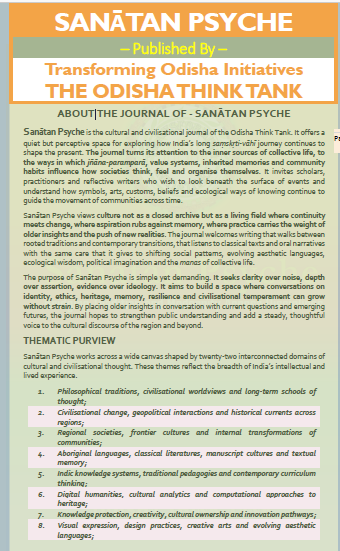
Sanātan Psyche is the cultural and civilisational journal of the Odisha Think Tank. It offers a quiet but perceptive space for exploring how India's long saṃskṛti-vāhī journey continues to shape the present. The journal turns its attention to the inner sources of collective life - the ways in which jñāna-paramparā, value systems, inherited memories and community habits influence how societies think, feel and organise themselves.

The Living Field of Culture

The journal invites scholars, practitioners and reflective writers who wish to look beneath the surface of events and understand how symbols, arts, customs, beliefs and ecological ways of knowing continue to guide the movement of communities across time.

Sanātan Psyche views culture not as a closed archive but as a living field where continuity meets change - where aspiration rubs against memory, where practice carries the weight of older insights and the push of new realities. The journal welcomes writing that walks between rooted traditions and contemporary transitions, that listens to classical texts and oral narratives with the same care that it gives to shifting social patterns, evolving aesthetic languages, ecological wisdom, political imagination and the manas of collective life.

Purpose & Voice

The purpose of Sanātan Psyche is simple yet demanding. It seeks clarity over noise, depth over assertion, evidence over ideology. It aims to build a space where conversations on identity, ethics, heritage, memory, resilience and civilisational temperament can grow without strain.

By placing older insights in conversation with current questions and emerging futures, the journal hopes to strengthen public understanding and add a steady, thoughtful voice to the cultural discourse of the region and beyond.

Contribute to Sanātan Psyche

Send your submission - research papers, essays, field notes, reviews, oral histories - to odishathinktank@gmail.com. Read the Submission Guidelines carefully before writing.

Read Submission Guidelines →

Twenty-Two Interconnected Domains

Sanātan Psyche works across a wide canvas shaped by twenty-two interconnected domains of cultural and civilisational thought. These themes reflect the breadth of India's intellectual and lived experience.

1Philosophical traditions, civilisational worldviews and long-term schools of thought.
2Civilisational change, geopolitical interactions and historical currents across regions.
3Regional societies, frontier cultures and internal transformations of communities.
4Aboriginal languages, classical literatures, manuscript cultures and textual memory.
5Indic knowledge systems, traditional pedagogies and contemporary curriculum thinking.
6Digital humanities, cultural analytics and computational approaches to heritage.
7Knowledge protection, creativity, cultural ownership and innovation pathways.
8Visual expression, design practices, creative arts and evolving aesthetic languages.
9Performing traditions, cultural animation and narrative forms of expression.
10Craft knowledge, artisanal technologies and the material imagination of communities.
11Heritage landscapes, architecture, archaeology and conservation-based inquiry.
12Cultural conflict, negotiation, peacebuilding and contemporary social tensions.
13Governance cultures, regulatory practices and institutional evolution.
14Folk histories, tribal life-worlds and comparative ethnographic perspectives.
15Traditional economies, livelihoods, ecological knowledge and order diversity.
16Nature–human relationships, coexistence thinking and eco-civilisational values.
17Maritime journeys, cultural exchange, mobility routes and global maritime memory.
18Defence traditions, martial knowledge and migration-based civilisational movement.
19Yoga, wellness traditions and community-oriented public health practices.
20Human–nature balance, flora–fauna wellbeing and ecological intelligence.
21Classical engineering, indigenous technologies and traditional scientific inquiry.
22Astronomy, spatial sciences, architectural cosmology and cosmic knowledge traditions.

Seven Journal Objectives

  1. To encourage research that shows how philosophical foundations, linguistic traditions, aesthetic movements, ecological knowledge and cultural habits shape the collective psyche.
  2. To deepen understanding of the narratives, values and social behaviours that guide public life, governance, creativity and the lived experience of communities.
  3. To document and interpret the continuities, disruptions and adaptations that define India's diverse knowledge traditions.
  4. To cultivate dialogue between classical insight, contemporary scholarship and lived practice so that older ideas remain meaningful in a changing world.
  5. To strengthen cultural literacy through the study of symbolism, memory, ritual spaces, identity-making and community worldviews.
  6. To support text-based and field-based inquiry that links culture with environment, social organisation, mobility, ecology and mental landscapes.
  7. To nurture writing that is reflective, rigorous, honest and attentive to the dignity and complexity of cultural voices.

Areas of Coverage

Sanātan Psyche invites research, essays and field reflections across these thematic families:

  • Civilisational & Philosophical Studies - classical worldviews, ethical traditions, long-term reflections, civilisational imagination.
  • Cultural & Social Thought - rituals, value systems, identity processes, social transitions, conflict and cohesion.
  • Languages, Texts & Knowledge Traditions - literary cultures, linguistics, manuscript knowledge, scholastic lineages.
  • Arts, Aesthetics & Creativity - visual arts, performing arts, craft traditions, design and aesthetic theory.
  • Heritage, Ecology & Cultural Landscapes - built heritage, archaeology, conservation, sacred geographies, nature–human relations.
  • Folk, Tribal & Indigenous Traditions - ethnography, oral histories, vanabasi lifeworlds, comparative cultural perspectives.
  • Traditional Economies & Ecological Knowledge - livelihood systems, biodiversity, cultural economies.
  • Maritime, Migration & Mobility Histories - sea routes, cultural crossings, mobility, defence traditions.
  • Wellbeing & Embodied Knowledge - yoga, wellness traditions, mind–body practices, community health.
  • Classical Sciences & Applied Knowledge - indigenous technologies, astral sciences, architecture, material knowledge.
  • Public Reasoning & Contemporary Society - governance, development, ethical questions, social resilience.

The Editorial Team

Executive Editor

The National Convenor of the Konark Dialogue of the Odisha Think Tank serves as Executive Editor of the journal. Manages the operational side of the journal - submissions, scheduling, communication and production. Supports the Chief Editor and the Content & Design Editor to ensure smooth, timely publication. All intellectual property associated with the journal remains with the Odisha Think Tank. Appointing and removal authority for all editorial and advisory members. Decisions are final.

Chief Editor

Provides the guiding direction for Sanātan Psyche, shaping the intellectual character of each issue, ensuring alignment with the journal's cultural and civilisational purpose, and upholding standards of clarity, balance and scholarly seriousness. Oversees the review cycle, final approvals and long-term thematic planning. Handles conceptual direction, thematic decisions and final editorial judgment.

Content & Design Editor

Refines manuscripts for clarity, structure, flow, transliteration and factual accuracy. Handles visual arrangement where required.

Thematic Editorial Team

Thematic Editors represent the journal's diverse domains. They evaluate submissions within their areas of expertise and advise the core editorial group on emerging topics. The journal invites scholars to join as Thematic Editors - interested individuals may send a brief bio-data to the Executive Editor.

Role & Responsibilities

  • Every Thematic Editor must contribute one research piece per issue.
  • Absence for two consecutive issues results in automatic cancellation of membership.
  • No role carries remuneration.
  • The Executive Editor holds final authority over appointments, continuation and removal.

Advisory Board

Chairman, Advisory Board

Appointed by the National Convenor of the Think Tank. Provides overall guidance and may recommend experts for inclusion.

Members, Advisory Board

May include persons from:

  • Teaching, research and academic work
  • Independent scholarship, writing and translation
  • Heritage, arts, ecology, literature, traditional knowledge
  • Freelance documentation, field research, cultural service
  • Public life, social work, cultural institutions
  • Literary and intellectual fields
  • Think tanks, educational bodies, civil society

Interested individuals may apply - the Executive Editor makes the final decision.

Governance Purpose

To provide broad intellectual guidance without interfering with editorial independence.

Chairmanship

  • Appointed by National Convenor of the Think Tank
  • Offers direction and recommends experts
  • Supports thematic depth and long-term positioning

Membership Structure

Eligibility spans academia, independent work, cultural practice, ecology, traditional knowledge and public life.

Mode of Joining

  • Invitation
  • Expression of interest + bio-data

All decisions by the Executive Editor.

Tenure & Continuation

  • Three-year tenure
  • Continuation based on contribution
  • Inactivity for two issues leads to removal
  • Executive Editor's decision is final

Protocols & Remuneration

  • Suggest themes; guide emerging concerns
  • Maintain dignity and confidentiality
  • No interference in editorial decisions
  • All positions are honorary - no payment

Intellectual Property

All intellectual property, except mentioned otherwise in specific cases, remains with the Konark Dialogue - the Odisha Think Tank.

Administration & Review Process

1
Initial Screening

Relevance, language, originality, guideline-compliance check.

2
Blind Peer or Expert Review

Reviewers focus on clarity, rigour, originality, depth.

3
Editorial Refinement

Authors work with editors on structure, clarity and accuracy.

4
Final Approval

Chief Editor and Executive Editor take the final decision.

Acknowledgment within 7 days; review within the quarterly publication cycle.

Submission Guidelines - Overview

Send all submissions to odishathinktank@gmail.com. These guidelines apply to all manuscripts, essays, field notes, reviews and reflections submitted to Sanātan Psyche. Contributors are strongly advised to read this document carefully before submitting their work.

1. Types of Contributions Accepted

1.1 Research Papers 5,000–8,000 words

  • Original and evidence-based
  • Strong conceptual grounding
  • Clear methodology (textual, field-based, historical, etc.)
  • Flexible length for exceptional work

1.2 Review Essays 2,500–4,000 words

  • Critical analysis of books, performances, archives or cultural works

1.3 Field Notes / Ethnographic Reflections 1,800–3,000 words

  • Based on fieldwork, interviews, community studies, heritage sites, ecological practices

1.4 Reflective Essays / Civilisational Commentaries 1,800–3,000 words

  • Thoughtful, non-sensational reflections
  • Cultural transitions, identity, ethics, memory, arts, public life

1.5 Oral Histories / Documented Conversations 1,500–4,000 words

  • Transcribed interviews with practitioners, elders, artists, scholars
  • Must include context, date and consent details

1.6 Short Notes / Brief Interventions 1,200–1,800 words

  • Observational pieces, archival discoveries, heritage updates

Interdisciplinary submissions are encouraged.

2. Manuscript Structure

Each submission must contain:

  • Title of the article
  • Author name(s)
  • Institutional affiliation (or "Independent Researcher/Writer")
  • Email address
  • Abstract (150–250 words)
  • 5–7 keywords
  • Main body of the text
  • References (APA 7th edition)

3. Language, Style & Transliteration

  • Submissions must be in English.
  • Clear, reflective human tone; avoid jargon and sensationalism.
  • Indic terms (saṃskṛti, jñāna-paramparā, dharma, artha, rasa, manas, vanabasi etc.) may be used.
  • Give a brief explanation on first use if required.
  • Use consistent transliteration (IAST preferred; a simple fixed scheme acceptable).

4. Formatting Requirements

  • Submit in .doc or .docx format (no PDFs for first submission)
  • Font: Times New Roman or equivalent, 12 pt
  • Line spacing: 1.5
  • Margins: Standard (1 inch)
  • Number pages consecutively
  • Minimal formatting; no text boxes or unnecessary styles

Images, Tables & Figures

  • Insert a placeholder in text (e.g., "Figure 1 here")
  • Provide caption and source for each figure
  • Send images separately as high-resolution JPEG/PNG
  • Authors are responsible for permissions

5. Referencing Style - APA 7th Edition

Sanātan Psyche uses APA (7th edition).

In-text Citations

  • One author: (Sharma, 2019)
  • Two authors: (Patnaik & Mishra, 2021)
  • Three or more: (Reddy et al., 2020)
  • Direct quote: (Kapadia, 2017, p. 42)

Books

ExampleThapar, R. (2013). A history of India. Penguin.

Journal Articles

ExampleTripathy, S. (2021). Cosmology and coastal imagination. Journal of Maritime Studies, 14(2), 112–130. https://doi.org/xxxxx

Chapters in Edited Volumes

ExampleMohanty, N. (2020). Oral narratives of eastern India. In R. Sen (Ed.), Voices of the land (pp. 55–78). Routledge.

Web Resources

ExampleMinistry of Culture. (2021). Cultural mapping of India. https://www.indiaculture.gov.in/mapping

Oral Histories

ExamplePanda, L. (2023, February 12). Personal interview by A. Sharma.

Scriptural References

ExampleUse traditional numbering (e.g., Bhagavad Gītā 2.47) or cite the specific published edition in APA.

A complete APA guide is available in the journal handbook.

6. How to Submit

Email your submission to odishathinktank@gmail.com.

Email Subject Line

Submission – Sanātan Psyche – [Article Type] – [Author Name]
e.g., Submission – Sanātan Psyche – Research Paper – A. Sharma

Attach

  • Manuscript (.doc / .docx)
  • Brief bio-note (100–150 words)
  • High-resolution images (if any)
  • Any permissions or notes

In the Body of the Email, Mention

  • Full name
  • Contact email
  • Affiliation (or "Independent")
  • Title of submission
  • Type of contribution

7. Review & Decision Process

Sanātan Psyche follows a tiered review system:

1
Initial Screening

Relevance, language quality, originality and compliance with guidelines.

2
Review

Blind peer review or expert evaluation - clarity, rigour, originality, depth, cultural sensitivity.

3
Editorial Refinement

Authors work with editors to improve structure, clarity and accuracy.

4
Final Decision

Chief Editor and Executive Editor take the final decision.

Timelines

  • Acknowledgement within 7 working days
  • Review and decision follow the quarterly publication cycle

8. Originality, Ethics & Plagiarism

By submitting, authors confirm that:

  • The manuscript is original.
  • It has not been published elsewhere in any form.
  • It is not under review elsewhere.
  • All borrowed ideas and quotations are properly cited.

The journal will:

  • Conduct plagiarism screening
  • Reject any work involving unattributed copying or excessive paraphrasing
  • Seek clarification for field-based work, community knowledge or oral histories

10. Ethical Practice for Fieldwork & Cultural Material

Authors working with communities, practitioners or heritage contexts should:

  • Obtain consent where possible
  • Represent people and traditions respectfully
  • Avoid misrepresentation, exploitation or distortion
  • Use sensitive material responsibly
  • Provide contextual details (date, place, method)

11. Remuneration

All contributions are voluntary. The journal offers no payment, honorarium or financial support.

12. Rights & Permissions

  • Authors retain copyright
  • Journal receives the right to publish, archive and disseminate
  • Reuse requires acknowledgement of Sanātan Psyche
  • Intellectual property remains with the Odisha Think Tank

14. General Expectations

  • Maintain respectful tone toward all traditions and communities
  • Avoid ideological rigidity or sensational claims
  • Ensure factual and cultural accuracy
  • Follow ethical practice in handling field data
  • Provide permissions for images, diagrams and materials

Author Declaration Form

Odisha Think Tank · Email: odishathinktank@gmail.com
Fill this form, print, sign and submit along with your manuscript and a passport-size photograph.

1. Manuscript Details

2. Declaration of Originality

I/we declare that:

  • This manuscript is an original work created by the undersigned author(s).
  • The work has not been published previously, in whole or in part, in any journal, book, website, or other medium.
  • The manuscript is not under review or consideration by any other publication at the time of submission.
  • All ideas, data, quotations, translations and references from other sources have been properly cited in APA 7th Edition format.
  • Any field-based material, oral history, photographs or community knowledge included has been used with appropriate consent and ethical responsibility.

3. Plagiarism & Integrity Statement

I/we confirm that:

  • The manuscript is free from plagiarism, including verbatim copying, improper paraphrasing or unacknowledged borrowing.
  • No part of the manuscript has been generated by artificial intelligence, except for minimal technical assistance (formatting/spell-check), which has been fully disclosed.
  • All conceptual work, arguments, interpretation and writing are entirely human-created.

4. AI Usage Disclosure

5. Copyright & Publication Rights

I/we understand and agree that:

  • I/we retain the copyright of the manuscript.
  • Sanātan Psyche and the Odisha Think Tank receive the right to publish, archive and disseminate the work in print and digital formats.
  • Any future republication elsewhere will acknowledge Sanātan Psyche as the original place of publication.
  • All intellectual property of the journal remains with the Odisha Think Tank.

6. Conflicts of Interest

7. Author Contribution Statement (for multi-author submissions)

8. Final Declaration & Signatures

I/we affirm that all statements made in this form are true and accurate to the best of my/our knowledge. I/we accept that any violation may result in rejection, withdrawal or future ineligibility for publication.

Fill up, scan and submit along with the paper and a passport-size photograph(s).

Quick Submission Checklist

Use this checklist to ensure your manuscript is complete and ready for review. Send all submissions to odishathinktank@gmail.com.

1. Before You Write

  • Your topic fits within the journal's cultural and civilisational themes
  • The work is original and not under review elsewhere
  • You understand the APA 7th edition requirements
  • You have followed ethical guidelines for fieldwork, interviews or cultural material

2. Manuscript Content

  • Title is clear and meaningful
  • Author name(s) included
  • Affiliation (or "Independent Researcher") mentioned
  • Email address provided
  • Abstract (150–250 words)
  • 5–7 keywords
  • Main text written in clear, grounded language
  • Indic terms explained on first use
  • Consistent transliteration (if used)
  • Proper headings and subheadings

3. File Format

  • Submitted in .doc or .docx
  • Times New Roman (or equivalent), 12 pt
  • 1.5 line spacing
  • Standard margins
  • Minimal formatting; no unnecessary text boxes

4. Figures, Tables & Images

  • All figures/tables numbered (Figure 1, Table 1 etc.)
  • Captions and sources included
  • Permissions obtained, if required
  • Images sent separately as high-resolution JPEG/PNG

5. Referencing (APA 7th)

  • All citations appear in-text and in the reference list
  • Reference list formatted consistently
  • Quotations include page numbers
  • Web sources include full URLs
  • Oral histories / interviews documented with date and context

6. Integrity, Plagiarism & AI

  • Manuscript is plagiarism-free
  • All borrowed ideas and quotations are cited
  • No AI-generated content
  • Any minimal AI used for formatting/checking is disclosed

7. Email Submission

Send to odishathinktank@gmail.com with:

Subject Line

Submission – Sanātan Psyche – [Article Type] – [Author Name]

Email body includes

  • Full name
  • Contact email
  • Affiliation
  • Title of submission
  • Type of article

Attachments

  • Manuscript (.doc / .docx)
  • Bio-note (100–150 words)
  • Images (if any), separately attached

8. Readiness Check

  • Manuscript is complete
  • Formatting is clean
  • References are accurate
  • All ethical and consent requirements addressed
  • You are ready for the review process

Intellectual Property Policy

  • Authors retain copyright
  • Journal receives rights to publish and archive
  • Reuse must cite original publication
  • Indigenous and community knowledge must be respected

Plagiarism Policy

  • Mandatory plagiarism check
  • No copied or unattributed material
  • Borrowed ideas must be cited
  • No simultaneous submission elsewhere

AI-Usage Policy

  • No AI-generated manuscripts
  • AI use for formatting must be disclosed
  • All arguments must be human-created
  • AI-patterned writing will be rejected

Ethics & Additional Guidelines

  • Accepts research papers, essays, field notes, reflections
  • Maintain respectful tone
  • Avoid sensationalism
  • Follow ethical guidelines for fieldwork
  • Images / maps allowed with permissions

Sanātan Psyche Values Human Insight and Authenticity

Sanātan Psyche values human insight and authenticity. AI-generated manuscripts are not accepted. AI may be used only for minor tasks (formatting, grammar checks) - such use must be clearly disclosed. Conceptual work, analysis and writing must be human-created. Manuscripts showing AI-patterned language may be rejected.

Publication Schedule

Sanātan Psyche follows a quarterly cycle, releasing one issue every three months:

1
Call for Papers

Themes and windows announced quarterly.

2
Submission Window

Manuscripts received via email.

3
Review & Editorial

Screening, blind review, refinement.

4
Finalisation & Release

Issue published in print and digital.

Special issues may be announced separately.

Ready to Submit?

Read the guidelines carefully, complete the Author Declaration Form, and email your manuscript to odishathinktank@gmail.com.

Open Submission Checklist →

Other Publications from the Odisha Think Tank

Book 1
The Geopolitical Imperative - Aligning
Download
Book 2
The Imperative of Thought - Memory & Meaning
Download
Book 3
The Imperative of Thought - Culture & Consciousness
Download
Book 4
The Imperative of Thought - Tradition & Reflection
Download

Vision & Objectives

Empowering Odisha's youth to be innovators, entrepreneurs, and leaders of tomorrow.

Core Objectives

  • Enhance youth employability through strong skilling programmes across all 30 districts.
  • Build a dynamic startup economy supported by mentorship, incubation and patient capital.
  • Promote inclusive economic growth and societal well-being - with tribal, coastal and interior districts at the centre.
  • Build a diaspora–home bridge that channels Odia global talent back into missions on the ground.

Strategic Pillars

  • Skilling & employability - sector-rooted programmes tied to the industries growing in Odisha.
  • Entrepreneurship & startups - mentorship, seed capital, incubation hubs at every regional chapter.
  • Inclusive growth - livelihoods for banavasi (tribal), women, coastal and interior communities.
  • Culture & heritage economy - turning GI craft, Odissi, temple architecture and pilgrimage circuits into dignified livelihoods.
  • Digital acceleration - building the state's public and private digital rails on open standards.

Flagship Projects

Odisha Youth Empowerment & Entrepreneurship Blueprint

A structured skilling-to-startup runway across every district - with hubs, mentors, and demand-rooted curricula.

Cultural Diplomacy & Diaspora Missions

Delegations, exchanges and curated publications that carry Odisha's civilisational voice into the world.

Banavasi Livelihood & Indigenous Cultural Economy

Community-owned livelihood models for tribal Odisha - forest produce, weaves, honey, art traditions.

Coastal & Industrial Zones Coordination Platform

Bridging Paradip, Dhamra, Gopalpur and Kalinganagar with the human capital they need - sensitively.

Art, Architecture & Public Aesthetics Council

A standing council to keep Kalinga's design language alive in modern civic and infrastructure work.

Digital Odisha Accelerators

Open-standards public digital infrastructure and the private startups that can build on it.

Youth-Led Enterprises & Internship Acceleration

Real placements, real capital, real ownership - not certificates.

The Next Founders - Students Spark-Catalyst Circle

An early-stage circle for school and college talent already building things.

Partnerships & Collaborations

The missions are delivered in partnership with Odisha's universities and technical institutes, industry bodies, philanthropic capital, the diaspora, cultural custodians and civil-society organisations working at the ground. Each partnership is rooted in a written charter and a public dashboard.

Youth Voices · Community Lens

Youth Voices

Field reports and reflections from the young people carrying these missions forward.

Community Lens

Village, ward and campus perspectives on what is actually shifting.

Founders' Notes

Short essays from the entrepreneurs building in and for Odisha.

Field Diaries

Frontline diaries from tribal, coastal and interior chapter volunteers.

Join · Volunteer · Apply

The missions rely on people. If you would like to volunteer with a specific mission, apply for a fellowship, or partner as an institution - write to the Secretariat, or complete the short expression-of-interest note through the Join / Volunteer / Apply page.

ବିଶ୍ୱ ଓଡିଆ ସଂଯୋଗThe Global Odia Bridge

❋ ◈ ❋

The Kaliki Avatar - Odisha Think Tank Global Connect is the standing bridge between Odisha and the wider Odia diaspora across the world. It supports the Global Odia Directory, diaspora collaborations, cultural diplomacy projects, comeback-to-Odisha entrepreneur programmes and scholarship partnerships that carry Odia talent between continents.

ନିର୍ବାଚନ କେନ୍ଦ୍ରTwenty-one Constituencies of Odisha

❋ ◈ ❋

The Odisha Think Tank's Constituency Focus programme carries a research-and-action lens to every parliamentary constituency in Odisha - from Bhubaneswar to Kalahandi, from Puri to Sundargarh. Each constituency has its own thematic dossier: demographics, industries, cultural heritage, developmental needs, chapter volunteers, and the priority missions active there.

ଚନ୍ଦ୍ରଭାଗାThe Research Voice of the Think Tank

❋ ◈ ❋

Insights and Intelligence is the analytical wing of the Odisha Think Tank - a place where policy briefs, research spotlights, thought-leadership essays, and governance-performance dashboards are prepared. It carries the flagship Chandrabhaga - the Voice of Konark, the Policy-Stream feed, and quarterly indexing of state programmes.

ପ୍ରକାଶନ ମାଳାThe Think Tank Publications

❋ ◈ ❋

The Odisha Think Tank publishes a series of journals, magazines and reviews carrying its research, cultural documentation and civilisational reflections - Trending Odisha Chronicles, Sanātan Psyche, The Eastern Holyland, and the Book Reviews stream. Contributors are welcome through the Publish-With-Us gateway.

ରାଜ୍ୟ ସଭା · ୧୦ ସଦସ୍ୟThe Ten Voices of Odisha in the Council of States

❋ ◈ ❋

The Rajya Sabha - the Council of States - is India's upper house of Parliament. Odisha sends ten members to the Rajya Sabha, elected by the Members of the Legislative Assembly through single transferable vote. The Kaliki Avatar - Odisha Think Tank tracks their legislative interventions, committee memberships, questions raised, and constituency work, and the state's civilisational voice they carry into the Council.

The Rajya Sabha & the Think Tank

Each sitting session, the Odisha Think Tank prepares a Rajya Sabha Interlinkages & Cooperation Brief for members from Odisha - policy interfaces between central legislation and Odisha's development priorities. Members are invited to consult the Chandrabhaga Policy Stream and Sanātan Psyche journal for evidence-rooted positions. This page also carries an archive of noteworthy interventions and questions.

କଳ୍କି ବ୍ରିଗେଡ୍Kaliki Brigades - The Freelancers of the Movement

⚔ ◈ ⚔

The Kaliki Brigades are the mobile, cross-district action units of the Odisha Think Tank - freelance karyakartas who do not belong to a single chapter or guild but rally, on call, wherever a mission requires disciplined action. They are the moving arms of the Kaliki Avatar - the sudden, decisive strike where dharma needs one.

Each Brigade is tied to a themed mission (Cyclone-Response, Cultural-Documentation, Digital-Rescue, Election-Watch, Heritage-Restoration, Emergency-Relief). Members earn their Bharat Assets Membership - a portable identity as an OTT-recognised freelance mobiliser, valid across chapters and guilds.

The Ten Standing Brigades

ଭାରତ-ସମ୍ପତ୍ତି ସଦସ୍ୟତାBharat Assets Membership Strategy

Bharat Assets is the OTT's freelance-mobiliser membership - an identity for those who serve the movement across geographies and themes rather than through a single institutional home.

  • Portable identity - one Kaliki Avatar ID number valid across all chapters, guilds and brigades.
  • Rapid-deploy roster - on-call for cyclone response, cultural documentation, election-watch, emergency relief.
  • Learning-and-earn - brigadiers rotate through short-cycle training (72-hour cyclone protocol, palm-leaf conservation, digital forensics for heritage sites) and receive attested certificates.
  • Recognition & honours - the annual Kaliki-Vīra Samman honours brigade members whose response has shaped a mission.
  • Register & join - via any chapter or the Secretariat; annual re-attestation.
Register as a Brigadier ›

ପ୍ରମୁଖ ବ୍ୟକ୍ତିତ୍ୱIcons of Legacy and Leadership

❋ ◈ ❋

Odisha's civilisational voice has been carried, across centuries, by torch-bearers - freedom-fighters, statesmen, poets, saints, scientists, artists and reformers whose lives shape the state's memory and its ambition. This hall gathers their portraits, life-stories, and reflections on why they matter today.

This is a living gallery - a first roster; entries expand as the Think Tank's research fellowships prepare full-length biographies.

ଆହ୍ୱାନ ଓ ପ୍ରସ୍ତାବCitizen Call to Action

❋ ◈ ❋

Every citizen of Odisha, of Bharat, of the Odia diaspora, is invited to file a Call to Action - a considered, focused list of ten demands or reforms - bound to one of the fifteen Transforming Action Programmes. Below are the most recent citizen calls, newest first. To file your own ten points, use the form further down.

Recent Citizen Calls - Newest First

File Your Own Ten-Point Call

Sign in, choose your programme, write ten short calls (each ≤45 words), and your voice enters the record.

Sign In & File Your Ten Points

Your ten calls - each ≤45 words. Point 1 becomes your headline everywhere.

ପ୍ରତିପାଦନBackground Feeder

❋ ◈ ❋

This is the admin surface for the two front-page voice panels - Impacts (timeless voices, scrolling left-to-right) and Vibes (living voices, scrolling bottom-to-top). Add, edit or remove entries below; the homepage pulls from this feeder on next page load. Data is saved to your browser (production will hand this off to the server admin).

IMPACTS - Mahapurush

VIBES - Living Voices

‹ Back to homepage

ନୀତି ପ୍ରସ୍ତାବ ମାଳାStrategic Policy Perspectives

❋ ◈ ❋

The Odisha Think Tank publishes considered policy perspectives on the most pressing questions of the state and the nation. Each perspective is a research-backed argument, offered to legislators, administrators and citizens as a contribution to public reasoning. Most recent perspectives appear first.

କାର୍ଯ୍ୟାନ୍ୱୟନ ପ୍ରସ୍ତାବImplementation Advocacy - The Memoranda

❋ ◈ ❋

The Think Tank's Implementation Advocacy stream is a running record of the memoranda we submit to governments, ministries, universities and public institutions - asking for specific, considered action on reforms the state and nation need. Every memorandum here has been shared with the addressee; every one is public. Most recent memoranda appear first.

Member
CHAPTER

Name

Role

This is a template profile. The member’s full biography, portfolio and contact details are being added.